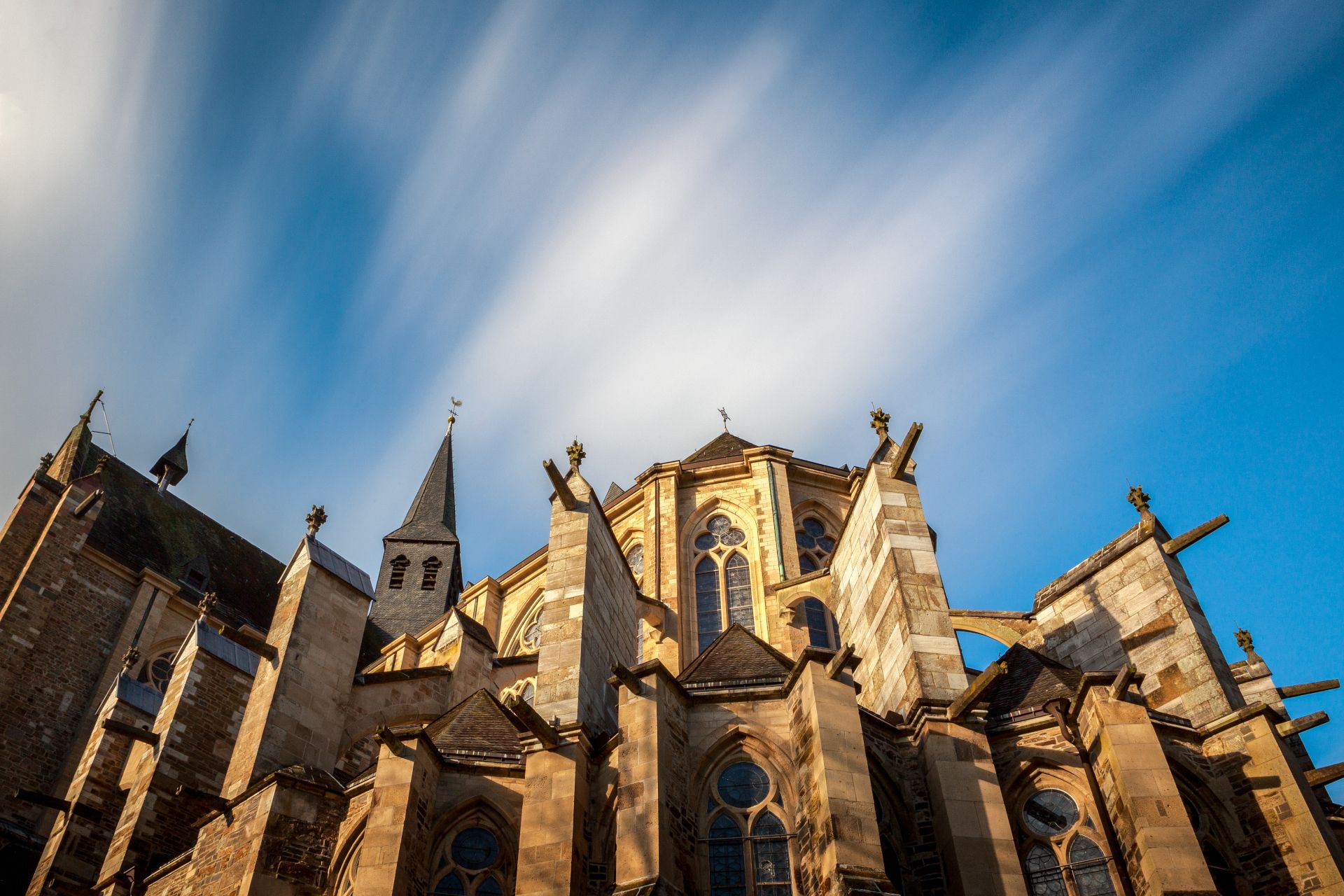
An excursion begins at the Altenberg Cathedral with a sense of having arrived. Here, you’ll find a cultural landscape shaped over centuries by collaboration, and a place that welcomes visitors with a rare blend of European significance and Bergisch warmth: Amid the wooded slopes of the Dhünn Valley, pilgrims on the Way of St. James and families alike come together. After a hike, they take a seat in one of the cozy taverns with views of the monastery, which are picturesquely scattered throughout the valley in Altenberg. It’s a wonderful place to relax with a Bergisch waffle topped with hot sour cherries. Before your eyes, the light-colored Gothic church rises up, appearing surprisingly large for these idyllic surroundings.
The simple, three-nave columned basilica appears as if out of nowhere upon arrival in the Odenthal-Altenberg district. It forms the heart of the area, which boasts meandering streams, green hills, historic monastery buildings, a fairy-tale forest, and exciting themed trails. Since 2024, it has been part of the “Cisterscapes – Cistercian landscapes connecting Europe” network, which has been awarded the European Heritage Label. The label honors places that not only preserve Europe’s history but also bring people together. In Altenberg, this can be experienced firsthand: as a shared cultural landscape that serves as a modern center of faith for Catholics and Protestants, a youth education center, and features its own 13.5-kilometer-long monastery landscape trail.
Here, a pond with water lilies and herons offers hikers the perfect spot to unwind. There, St. Mark’s Chapel, with its late Romanesque monastic architecture, catches the eye as you stroll by. A little further on, the cathedral shop in the oldest part of the former monastery offers books, souvenirs, and hiking provisions to take along. The fact that this landscape remains so open and yet so distinctive to this day is due to the Cistercians. In 1133, monks from the French mother monastery of Morimond came to the Dhünn Valley at the invitation of the Counts of Berg. They brought with them not only their strict monastic rules but also knowledge of agriculture and trade, as well as a deep inner warmth. Ponds, mills, farms, and paths were established. The Dhünn River provided water and power. The farms supplied the monastery and the region. Thus, in the Dhünn Valley, prayer and work did not mean withdrawing from the world, but rather carefully shaping it and opening it up to others. Within the European network Cisterscapes, Altenberg therefore embodies the Cistercian ideal of “stabilitas loci”—that is, a connection to a place, responsibility, and long-term community.
Major Threads of Regional History
The cathedral, whose construction began in 1259 and was consecrated in 1379, still welcomes guests today with a certain warmth. Here, of all places, it creates space for silence as well as for communal worship services and concerts. The light streaming through the grisaille windows in the choir is particularly striking. In subtle shades of white, gray, and black, they largely forgo figurative representations, allowing light and shadow to speak for themselves. The large west window, created at the end of the 14th century, provides a striking counterpoint. It depicts the Heavenly Jerusalem, surrounded by biblical figures, Church Fathers, and angels making music. Measuring approximately 8 by 18 meters, it is considered the largest church window north of the Alps.
Those who linger here a while will also encounter the history of the Counts of Berg: the window was commissioned by Duke Wilhelm von Jülich-Berg, whose dynasty left a lasting mark on the Rhineland region. His ancestor, Count Adolf von Berg, founded what is now the Rhine metropolis of Düsseldorf. He is buried in Altenberg Cathedral alongside other members of his family. Thus, the building not only connects art, faith, and landscape; it also bridges the major threads of regional history.


