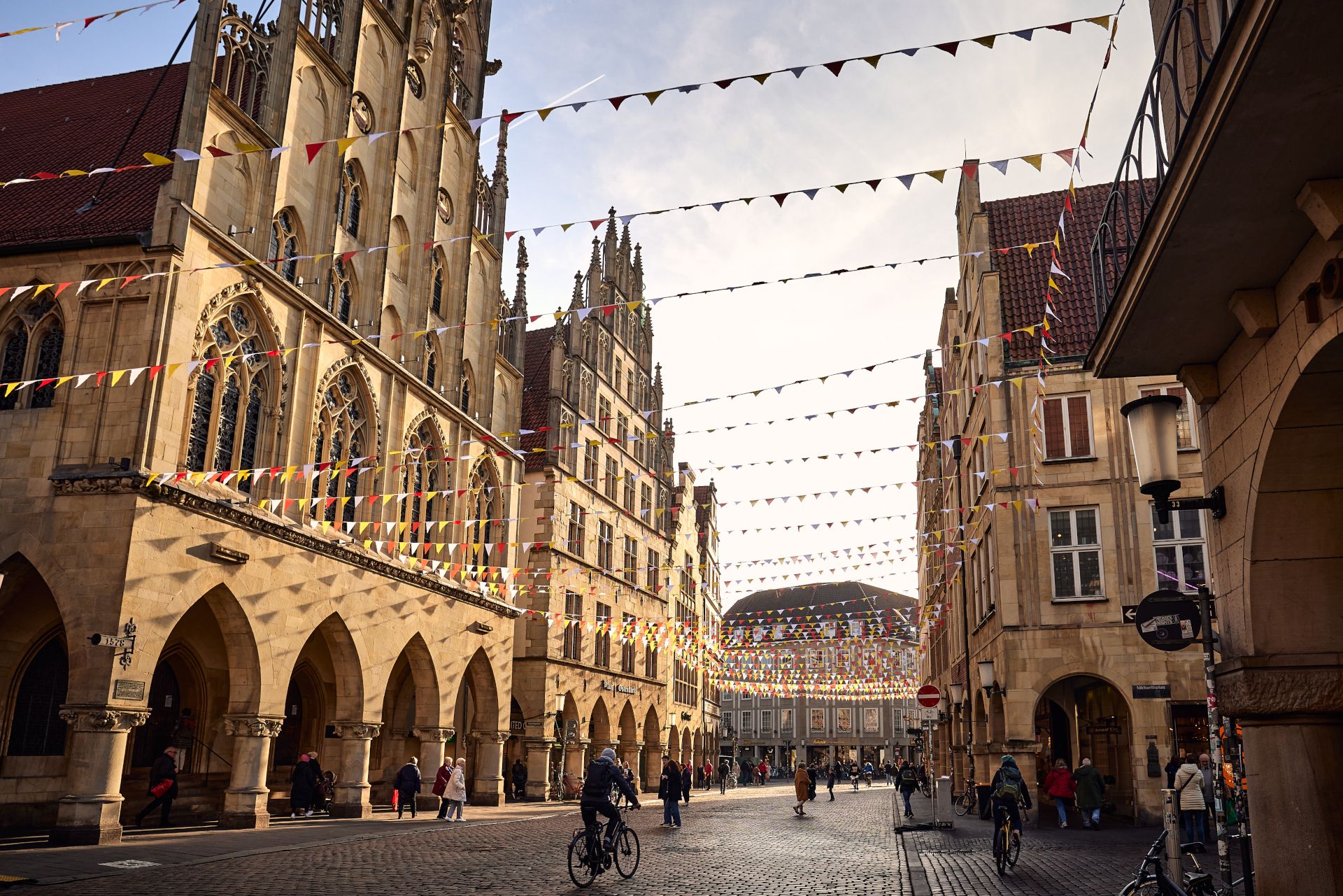
The best way to start a trip to Münster is where the city is still at its most lively today—where bustling activity meets historic architecture: at the arcades of the Prinzipalmarkt. Here, friends laugh at the tables of the cafés. Market-goers cross paths with students. Cyclists whiz across the cobblestones. Above them rises the Gothic façade of the Historic City Hall. It serves as a reminder that community can emerge anywhere. Sometimes, sovereigns and envoys even negotiate for years over it, until they finally achieve peace.
Since 2015, the town hall—along with the Osnabrück Town Hall—has held the European Heritage Label as part of the Sites of the Peace of Westphalia. In the Peace Hall of the Gothic building, this far-reaching history takes on a surprisingly personal character: the carved wooden paneling, the portraits of ambassadors and rulers, the fireplace with its pediment figure of Justitia holding a sword and scales. This is a place where people sat together, argued, waited, and ultimately listened to one another. Next to the fireplace, a copperplate engraving based on a painting by Gerard ter Borch depicts the scene from May 15, 1648, when the envoys of King Philip IV of Spain and the Republic of the Seven United Netherlands solemnly ratified the Spanish-Dutch Peace here.
Standing before it, with a little imagination, one can picture oneself mingling among the delegations. A brief journey of the mind makes it clear just how much hope lay in this gesture. The Peace of Westphalia in 1648 ended the Thirty Years’ War in the Holy Roman Empire and the Eighty Years’ War between Spain and the Netherlands. As a result, Münster and Osnabrück became European meeting places for years to come: Envoys, messengers, clergy, and courtiers from many territories and denominations gathered there. Although the final peace treaty of October 24, 1648, was not signed in the Peace Hall, Münster’s City Hall served as a central social and diplomatic venue for the negotiations. The European Heritage Label honors this history as a symbol of religious tolerance, mutual understanding, and the development of a European peace order.
Council Chamber and Citizens’ Hall
Architecturally, too, the City Hall tells a story of coexistence. It was built starting in the mid-14th century as a Gothic civic hall and had a clear layout: the council met in the rear Council Chamber, while the city’s citizens gathered in the front Citizens’ Hall. Later, the five round pillars of the arched hall were added to the façade facing the Prinzipalmarkt. An open passageway was created, connecting the town hall to street life. Even the peace banner, which the council had commissioned in 1649 to proclaim the peace treaties, stands as a symbol of understanding in the Citizens’ Hall. It depicts a white dove with a green branch in its beak, the golden imperial crown of the Habsburgs, outstretched hands holding palm branches, and the city coat of arms of Münster.


