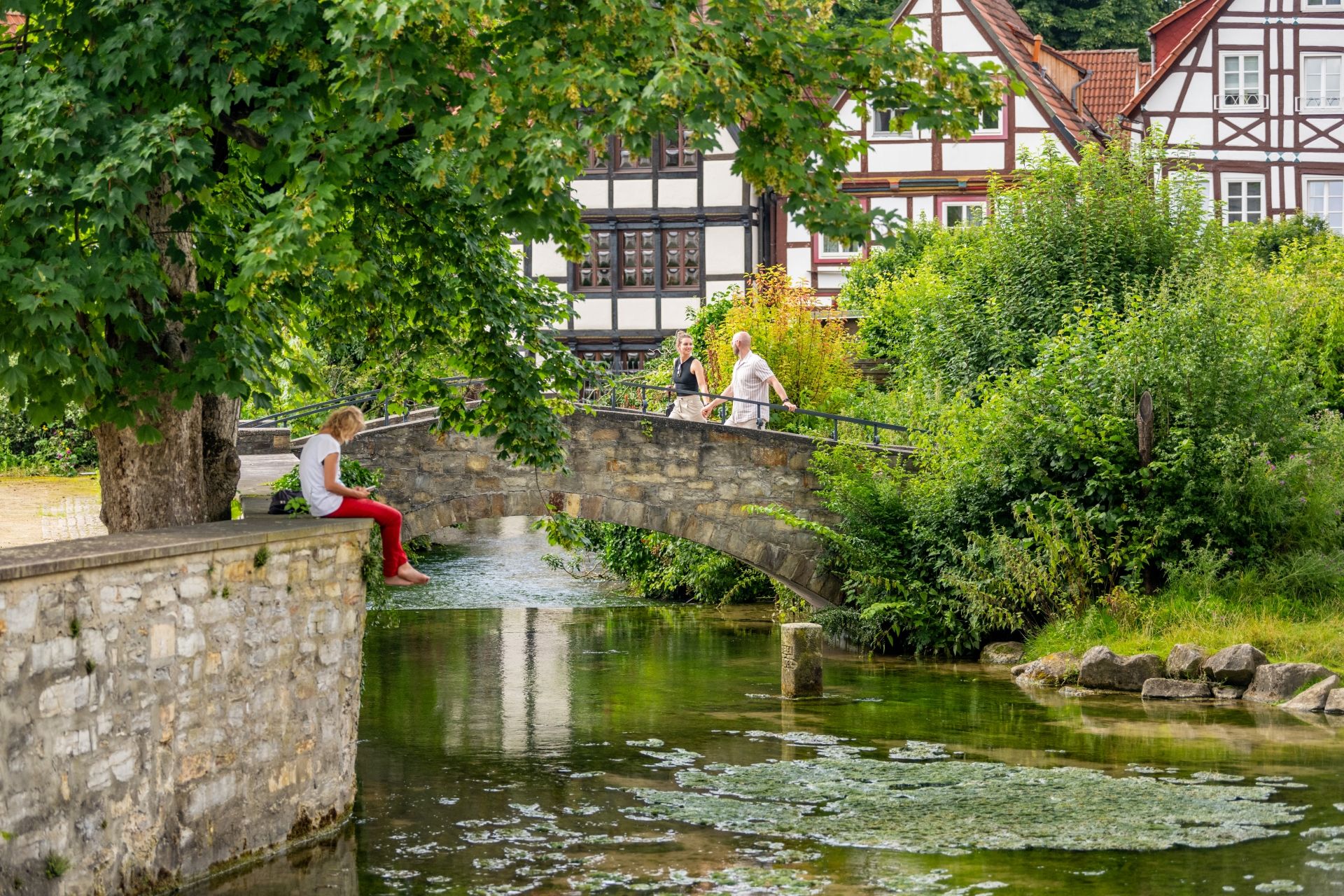
Germany’s shortest river flows right through the heart of Paderborn. Over a stretch of just 4.6 kilometers, the Pader shapes the cityscape—not as a wide river, but as a dense network of waterways that winds its way directly between the cathedral, half-timbered houses, and bustling shopping streets. And as in any city by the water, places for socializing and unwinding emerge here as well.
Just a few steps away from the hustle and bustle of downtown, students sit on the grass, working professionals spend their lunch breaks on the riverbank, and passersby listen to the soothing sound of the water. The Pader headwaters form an urban river landscape where water emerges from more than 200 karst springs. Nowhere else in Germany does so much water gush from the ground right in the middle of a city.
Six spring branches flow here through walled basins, past shaded paths and small green spaces. Upon closer inspection, fine bubbles and small whirlpools reveal what’s happening deep below. On the outskirts of downtown, the watercourses converge to form the Pader proper, until it finally flows into the Lippe in the Schloß Neuhaus district—carrying, on average, even more water than the larger river itself.
A Break from the Hustle and Bustle of Everyday Life
A walk along the Pader leads from the historic downtown out into the countryside. No sooner has the river left the old walls and half-timbered houses behind than a view of the expansive Pader meadows opens up. Under tall trees, joggers and cyclists share the paths, while families spread out their picnic blankets. Hikers take a break on the wide natural stone walls of the pools. In many places, the water comes so close to the paths here that they simply take off their shoes and dip their feet in the cool water.
For a coffee break, the Mühlencafé—located close to the city center—offers seating right by the water. Further downstream, the Pader widens into Lake Pader, where small sailboats and waterfowl glide across the surface. Right on the shore, the Pader Café serves homemade treats and specialty coffees from its own roastery. Just past the lake, the Pader finally flows into the Lippe at the Schloß Neuhaus residence.
How the Pader Has Shaped Paderborn
In this Westphalian city, almost everything revolves around water and springs. This is evident even in its name, which is derived from the river name “Pader” and the Old High German word “Born,” meaning “spring.” Literally translated, Paderborn means “Pader Spring” or “the place where the Pader rises.” In recognition of the unique interplay of nature, urban planning, and a sustainable water culture dating back more than 1,200 years, the European Commission awarded the Pader river landscape the European Heritage Label in 2026 under the motto “City.People.River.” With this award, the EU honors sites that play a defining role in European history, culture, or integration.
A stroll along the riverbank takes you right into the city’s centuries-old history. Even Charlemagne recognized the strategic value of the springs and had his palace built here in 777. A good twenty years later, Paderborn became a center of European diplomacy when Pope Leo III, having fled Rome, sought refuge with Charlemagne. This encounter paved the way for the founding of the Diocese of Paderborn and laid the foundation for Charlemagne’s imperial coronation in Rome. One of the Pader springs can still be viewed today in the historic vaulted cellar of the LWL Museum in the Imperial Palace.
From Clattering Mills to a Waterfront City Park
Because the springs never freeze, even in the depths of winter, the Pader provided enough power year-round to operate numerous water mills. These mills made Paderborn a prosperous Hanseatic city in the Middle Ages. People’s daily lives also unfolded right along the river: Along the “Dielenpader,” narrow wooden planks led across the water to the front doors of houses. Along the mild “Warme Pader,” women continued to wash their laundry by hand well into the 1950s. A bronze sculpture on the riverbank serves as a reminder of this era today.
Of the original watermills, the Stümpelsche Mühle at the confluence of the six Pader tributaries in the city center, as well as the Reinekemühle and the Schwarzendahls Mühle further downstream, still stand today. After the destruction of World War II, city planners opted against dense development and instead created a park along the waterfront. In recent years, Paderborn has gone a step further and restored the river to its natural form. Concrete banks have given way to shallow gravel banks and wide natural stone steps. At these spots, the murmur of the springs momentarily slows the pace of downtown life.