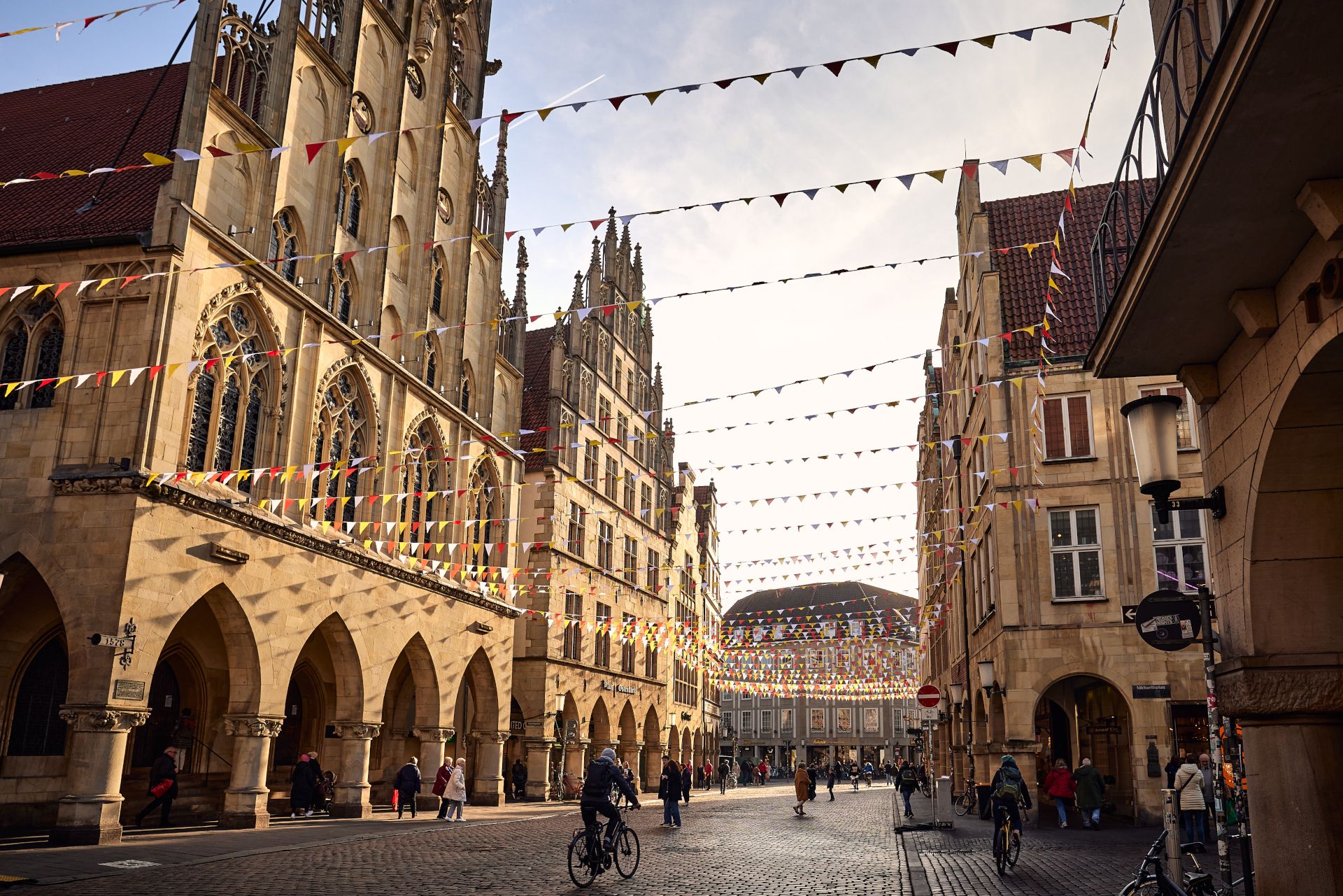
The Historic Town Hall is a Gothic building dating from the mid-14th century. The building is characterised above all by its tall and imposing gables. The Town Hall in Münster city centre gained particular fame on 15 May 1648, when the Peace of Spain and the Netherlands was concluded in the Town Hall’s Peace Hall. On 24 October of the same year, the Thirty Years’ War was brought to an end in the Town Hall, and the Peace of Westphalia was thus concluded. To this day, the Historic Town Hall is regarded as the site of the Peace of Westphalia. It was awarded the European Heritage Seal on 15 April 2015.
Tour of the Peace Hall
The Historic Town Hall houses the Peace Hall, where the Peace of Spain and the Netherlands was concluded in 1648. The Peace Hall is open to visitors: on weekdays from Tuesday to Friday, as well as at weekends and on public holidays. Opening times may vary on certain days due to events and receptions.
Guided tours of the Peace Hall are available via an audio guide or as part of a city tour.
History information
Münster's town hall was built in 1477. The Gothic building became famous in 1648, when the peace treaties for the Peace of Westphalia were negotiated in Münster and Osnabrück between 15 May and 24 October. The Peace of Westphalia ended the Eighty Years' War of Independence of the Netherlands and the Thirty Years' War in Germany on 24 October in Münster.
During the Second World War, a large part of the town hall was destroyed. It was completely rebuilt true to the original in the 1950s. The historic building was awarded the European Heritage Label on 15 April 2015.
Today, the Peace Hall in Münster's historic town hall features masterpieces of carving art and portraits of the sovereigns and envoys who signed the Spanish-Dutch peace treaty in Münster.